


By Donald Luverne | 7 min read
If you blinked in the last six months, you missed one of the sharpest rate recoveries the freight industry has seen since 2021. Truckload rates have increased sharply and tender rejections are running nearly 16%, meaning carriers are turning down loads at a rate that signals a market flipped hard in their favor. And six days ago, the U.S. Supreme Court handed down a unanimous decision that is going to change how every freight broker in America thinks about which carriers they call.
This is not a normal market moment. And if you're an owner-operator, small carrier, or private fleet manager running on gut feel and a rough sense of your costs, this is exactly the wrong time to be guessing.
I've spent years staring at financial data across multiple industries. The numbers always tell you the truth. The problem is most people aren't looking at the right numbers - or any numbers at all, before they accept a load.
Spot rates were sitting around $2.20 per mile last fall. They're $3.49 today and spot load posts climbed more than 70% year-over-year in February alone, well ahead of available truck supply. Tender rejections tell you why: carriers are turning down nearly 1 in 6 loads, levels not seen consistently since the post-COVID unwind in 2022. The trucks with options are using them.
After three brutal years of margin compression — carrier cost inflation running approximately 25% while rates stayed flat or fell — the market has snapped back hard. After nearly four years of watching rates bleed out, the carriers still standing have pricing power they haven't seen since 2021. That's the good news.
Here's the catch: a hot rate market doesn't automatically mean profitable loads. High rates can mask bad loads just as easily as low rates. If your cost profile is stale, if you're not accounting for detention, multi-stop complexity, HOS compression, or deadhead exposure — you can still lose money on a load that looks great on paper. Industry analysts are already calling this a structural shift rather than a short-term fluctuation, which means the operators who build real cost discipline now are the ones who will hold margin when the cycle turns again.
And now there's a new dynamic in play.
On May 14, 2026, the U.S. Supreme Court handed down a unanimous 9-0 decision in Montgomery v. Caribe Transport II, LLC. The ruling strips freight brokers of the federal preemption defense they've relied on for years against negligent hiring lawsuits. In plain English: brokers can now be sued in state court when they select an unsafe carrier that causes an accident and the ruling reinforces that carrier selection is a safety and risk management responsibility.
What does that mean for carriers? Brokers are about to get serious about who they tender loads to. Carriers with clean safety records, professional operations, and documented compliance are going to get preferential access to freight. Carriers who can't demonstrate that are going to find doors closing, regardless of what rates are doing.
Your operational reputation just became a revenue asset. And knowing exactly which loads you should be running and which ones you should pass on — is now both a profitability decision and a professional positioning decision.
Here's where it gets specific, and this is the part most operators skip entirely.
A load doesn't just cost you fuel and driver time. There's a whole category of load characteristics that quietly add real dollars to your cost structure and if you're not accounting for them before you accept, you're finding out after the fact. Or worse, never finding out at all.
Detention. According to the American Transportation Research Institute, 39.3% of all truck stops experience detention and detention time reduces net income of for-hire motor carriers by $250 million to $320 million annually industry-wide. That's not an abstraction. Eliminating just 30 minutes of wait time at pickup and 30 minutes at delivery would be equivalent to 50 additional revenue miles per day, or 12,500 miles per year per driver.
Multi-stop loads. Multi-stop loads lead to longer transit times and loading or unloading delays, which directly impacts the driver's HOS as well as revenue-generating miles overall. Every extra stop is a hidden tax on your time, your driver's available hours, and your ability to pick up the next load.
HOS compression. This one is subtle and brutal. A load that burns through your driver's available hours faster than expected doesn't just cost you time on that load, it pushes your next available pickup window back, sometimes by hours. The ripple effect on weekly revenue can be significant, and almost nobody calculates it before they say yes.
Deadhead miles. Research indicates that up to 35% of all miles driven by trucks on U.S. roads are empty, non-revenue-generating travel that increases fuel consumption and operational costs. If the backhaul situation on a lane isn't favorable, that return cost belongs in your load calculation. Period.
Fuel and variable costs shifting. Diesel prices don't stay still. Your cost per mile from last quarter may not reflect what you're actually spending today. A load that made sense at $3.50 per gallon may not make sense at $3.90.
If you manage a private fleet for a shipper, you might be reading this thinking it doesn't quite apply to your world. It does.
Private fleets operate on cost-per-mile economics just like for-hire carriers. The same detention penalties, the same HOS constraints, the same fuel variability. All of it hits your cost structure. The difference is that private fleet operators often have even less visibility into load-level profitability because the freight is captive and the tendency is to just run it.
Private fleets continued to gain market share through 2025, supported by stable service models and higher driver pay, but that stability doesn't mean the cost management gets easier. It means the margin for error is smaller, because you're not shopping loads competitively. You're running what you're handed. Which makes knowing your true cost per load even more important.
In a hot market, the temptation is to run everything. Rates look good, the phone is ringing, and after three years of grinding through a downcycle, it feels like the right move is just to say yes to every load that comes your way.
That's the wrong instinct.
High rates create the illusion that every load is a good load. They're not. Detention still costs you hours. Multi-stop complexity still compresses your driver's HOS. Deadhead exposure on a bad lane still eats your margin. And a load that pays $3.50 a mile with two stops, a two-hour wait at the dock, and a 200-mile empty return isn't the same load as one that pays $3.10 clean, direct, and drops you in a strong backhaul market.
The carriers who build real wealth in a strong cycle aren't the ones who run the most loads. They're the ones who run the right loads — consistently, deliberately, and with a clear-eyed view of what each one actually costs them.
You have leverage right now that you haven't had in years. Use it to get selective — not just on rate, but on the full load picture.
I built Haul Score — Load Profitability Analyzer because I got tired of watching smart operators leave money on the table — or worse, lose it, because they didn't have a fast, simple way to score a load before accepting it.
You enter your lane details, your costs, and the offered rate. Haul Score calculates your Load Profitability Score instantly and gives you a plain-English recommendation: Run It. Review It. Pass on It.
It accounts for the things that actually matter — detention defaults, fuel cost, driver pay structure, deadhead miles, fixed and variable cost breakdown, HOS assumptions, and your minimum acceptable margin. Not just rate per mile.
And if you want to go deeper on any load, the AI Advisor tab lets you ask plain-English questions and get specific, context-aware analysis, with one click on the load row. No prompting required. No spreadsheet skills needed.
You can also run multiple lanes side by side on the dashboard and see which ones actually score, so when you have choices, you're picking the right ones.
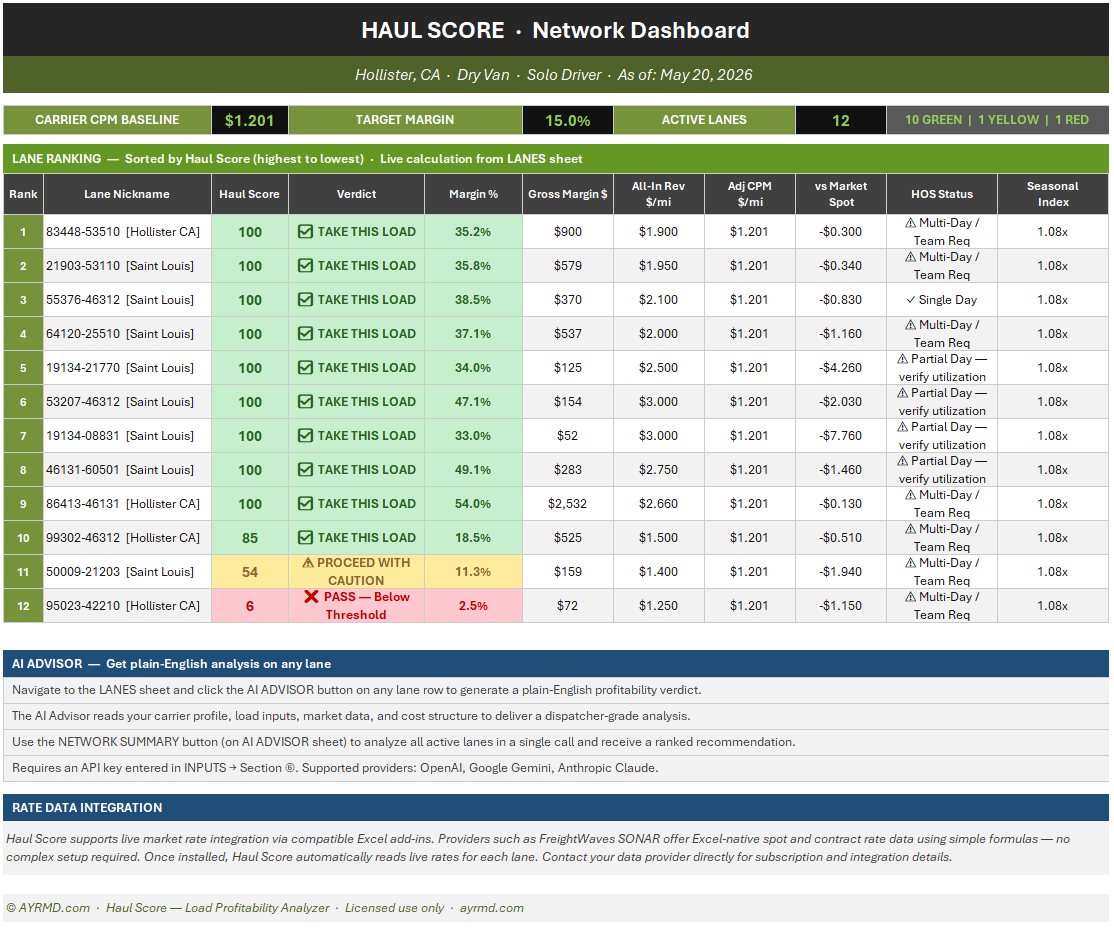
The freight market is in a transition. Cost profiles from a year ago are no longer relevant. Hidden load costs are real and quantifiable. And the carriers who come out of this cycle in the best shape will be the ones who treated every load like a business decision, not a gut call.
Haul Score gives you the tool to do that. Download it once. Use it forever.