


By Donald Luverne
If you work in logistics, you already know the freight market in 2026 feels different. Spot rates climbed more than 23% year-over-year from March 2025 through February 2026, and the gap between spot and contract pricing has compressed to its tightest level in years. Carriers are regaining pricing power. Budget assumptions made six months ago are already stale.
For shippers, brokers, and procurement teams, that creates a familiar pressure: you need a rate outlook, you need it to be defensible, and you have about 20 minutes to produce it.
Most rate intelligence tools assume you have time and budget for a subscription platform. DAT, Freightos, and others are excellent, but they're built for teams with dedicated analysts and $200–$500 a month to spare. If that's not you, you've probably been running on instinct, broker calls, and market commentary that's already two weeks old by the time it reaches you.
There's a better way and it's already sitting in your existing rate data.
The Truckload Rate Forecaster is a spreadsheet tool that turns your historical weekly rate data into a forward-looking seasonal outlook for your specific lane. Not a national index. Not a blended average. Your lane. Your data. Your forecast.
Here's the entire workflow:
That's it. No formulas to write. No configuration. No learning curve. One click produces a 5-quarter seasonal outlook showing expected rate direction, the magnitude of change in $/mile, the percentage change, and a volatility rating for each upcoming quarter.
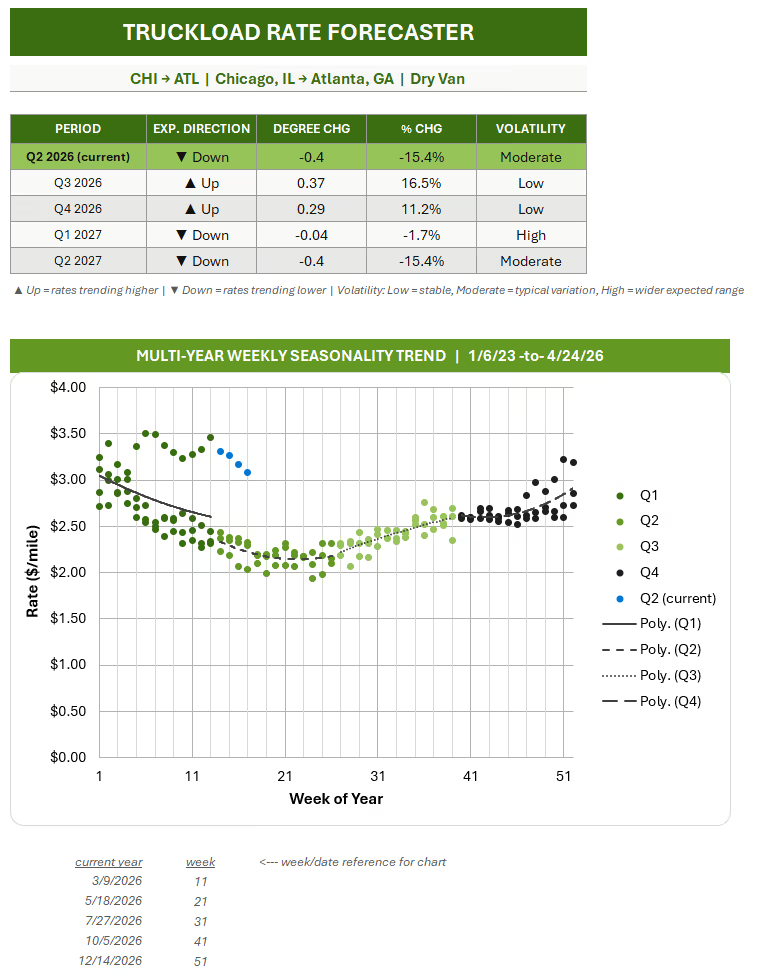
A lot of forecasting tools use complex prediction models that are hard to explain and harder to defend. This tool does something simpler and more honest: it identifies the recurring seasonal patterns in your own rate history and projects those patterns forward.
Every freight lane has a rhythm. Rates soften in certain quarters and tighten in others, driven by produce seasons, retail peak, weather, and regional capacity cycles. If you have a year or two of weekly rate data for a lane, those patterns are already in there. The forecaster finds them and makes them visible.
The output isn't a prediction of exactly where rates will be. It's a directional guide — up or down, by roughly how much, with more or less confidence depending on how consistent that quarter has historically been. Low volatility means the pattern is reliable. High volatility means plan for a wider range.
Here's what makes this tool particularly useful in the current market: the seasonal patterns in your lane data don't disappear just because the rate level is elevated. The basis is higher in 2026, but Q3 still typically behaves differently than Q1, and Q4 still tightens the way it always does.
If your historical data shows that rates on your lane typically soften 12% in Q2 relative to Q1, that seasonal dynamic is likely still in play, even if the starting point is $3.20/mile instead of $2.60/mile. The forecaster captures that relative movement, so you're not flying blind even in an unusual market.
That's the insight that separates lane-level historical analysis from reading market commentary. Commentary tells you the national average went up. Your data tells you what your lane tends to do next.
Logistics and procurement professionals are not short on problems to solve. Rate forecasting often falls into the category of things everyone knows they should do but nobody has time to set up properly. The Truckload Rate Forecaster is designed specifically for that reality.
There's no setup beyond pasting your data. No account to create. No API to connect. No training session required. You open the file, paste your rates, click a button, and get a result you can share in a meeting or drop into a budget model.
As new rate data comes in each week, you add a row and click Refresh. The forecast updates automatically. The whole process takes less time than reading a market update email.
If any of these describe you, this tool was made with you in mind:
The Truckload Rate Forecaster is available now for a one-time purchase of $29. No subscription. No renewal. One file, one lane, yours to use and update as long as you need it.